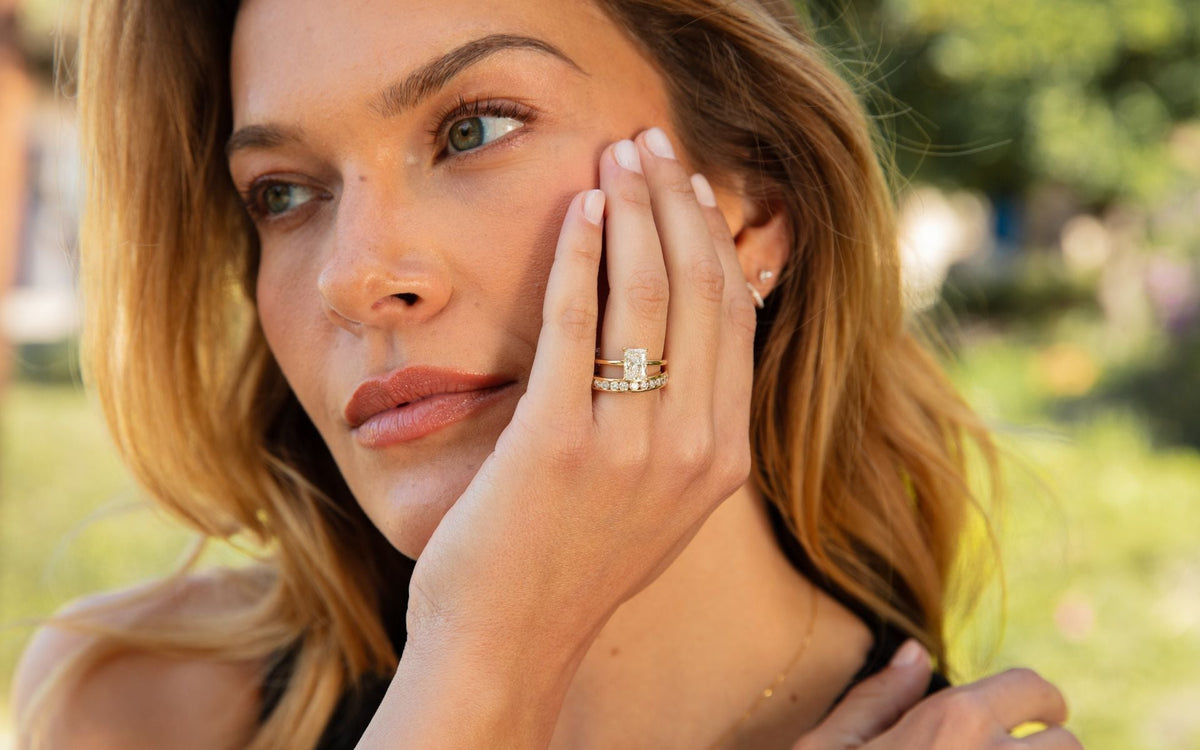

Prong setting - how the prongs hold your diamond perfectly in the ring

You want it traditional? The prong setting, also known as the claw setting, is one of the most popular and traditional types of setting in the world of jewelry. Especially for diamond rings, engagement rings and classic pieces of jewelry, it is considered the epitome of timeless elegance and allows a diamond or gemstone to be presented in a way that shows off its full beauty. The gemstone remains almost completely visible thanks to the narrow design and the fine prongs that hold the stone securely in place. This is precisely why this setting has been appreciated for centuries and reinterpreted time and time again.
The most important facts at a glance
Features of the prong setting - the prongs hold the diamond in place
Get to know the most famous and sparkling diamond cut with its high brilliance.
Learn more
History & development of the ideal setting for rings and other jewelry
Find out how the setting came about and how it became one of the most popular jewelry settings over time.
Learn more
Advantages and disadvantages of prongs on jewelry
Weigh up the pros and cons of the claw setting and find out whether it suits you.
Learn more
What is the best way to show off the prong setting in jewelry?
Explore the design options offered by the frame variant.
Learn more

Features of the prong setting - the prongs hold the diamond in place
The prong setting is characterized by its open, elegant structure, in which the diamond or gemstone is held by several fine metal claws - the so-called prongs. These claws grip around the round edge of the stone and are slightly bent at the upper end so that they hold the stone securely in place without obscuring its shape or brilliance. Different numbers of prongs are used depending on the design and size of the gemstone:
- Three prongs are often suitable for teardrop-shaped or triangular stones
- Four prongs look particularly harmonious with round or oval cuts
- The classic and most secure variant, however, is the 6 prong setting, in which the stone is particularly stable and is held reliably even when worn daily.
Due to the reduced amount of precious metal, the prong setting allows an exceptionally high incidence of light. This free access from all sides makes the stone sparkle more intensely, gives it more optical volume and emphasizes its natural beauty. At the same time, a large part of the gemstone remains visible, which is a significant advantage, especially with high-quality cut diamonds or colored gemstones. The prongs can have different shapes - narrow, wide, pointed or round - and are precisely adapted to the cut and size of the stone so that they neither reduce the brilliance nor detract from the aesthetics of the piece of jewelry.
Another characteristic feature is its versatility: the prong setting is suitable for almost all cut shapes, including brilliant cut, oval cut, emerald cut or drop shape. It looks light, delicate and high-quality at the same time. The free design of the prongs allows a wide variety of styles to be created - from classic to romantic to modern. In combination with other types of setting, such as pavé or bezel settings, a harmonious overall look is created in which the central stone is shown to its best advantage.

History and origin of the prong-set ring
Today, prong settings are internationally recognized and widely used, but their origins go back a long way. The first forms of this setting can be traced back to the Middle Ages, when goldsmiths began to use metal claws to hold gemstones in place rather than simply setting them flat or in closed settings. However, these early variants were not so much used to catch the light, but rather to keep the gemstone visible while still holding it firmly in the metal. The tools were still crude and the cuts at the time were rather rudimentary, but the basic idea of the "claws" holding the stone was already there.
Goldsmithing techniques developed further during the Renaissance and Baroque periods. Gemstones were now cut more precisely and became more popular as decorative elements in ornate pieces of jewelry. At this time, craftsmen increasingly experimented with settings that allowed a better view of the stone. Nevertheless, the bezel setting remained predominant for a long time, as it was considered particularly secure. It was not until the 18th and 19th centuries, when brilliant cuts were developed, that interest grew in more open types of setting that maximized the incidence of light.
However, the prong setting experienced a decisive breakthrough in the 19th century when new, more precise tools became available in the course of industrialization. Goldsmiths were now able to produce finer prongs that were both secure and delicate enough not to obscure the view of the stone. Its popularity continued to grow as the major jewelry houses of Europe and later America began to use prong settings in high-end diamond rings.
The setting became internationally known primarily through the development of the modern round brilliant cut (1919) and the subsequent trend towards solitaire aesthetics. A milestone was the marketing of the solitaire ring in the iconic 6-claw version, which makes the diamond appear to almost float. This shape set new standards, as it not only securely fixes the stone, but also gives it an intense brilliance thanks to the optimal incidence of light. In the first half of the 20th century in particular, the prong setting became synonymous with classic diamond engagement rings.
With the advent of modern jewelry design in the 20th century, supported by CAD technology and more precise metalworking, the prong setting was further perfected. Today, variations such as 4-claw, 6-claw, double-claw or filigree micro-claw settings are among the most widely used types of setting worldwide. Despite its long history, the prong setting appears timeless and modern - one reason why it can be found in luxurious haute joaillerie pieces as well as in simple everyday rings.


Advantages and disadvantages of prongs on jewelry

However, as the gemstone is only held at a few points, there is generally a slightly higher risk that one of the prongs will bend or wear out over time. A damaged prong can impair the hold of the stone, especially if worn frequently, which is why regular checks by a jeweler are recommended. In addition, the prong setting offers less protection against knocks than a bezel setting, for example, which completely encloses the stone. This can be a relevant factor for more sensitive gemstones or for people who wear their jewelry daily and under increased stress. The risk of the prongs catching on clothing or fine fabrics is also somewhat greater, especially if the prongs have not been perfectly smoothed or adapted to the shape of the stone.
What is the best way to show off the prong setting in jewelry?
A prong setting is particularly suitable when a gemstone is to receive all the attention. It is ideal for engagement rings because it perfectly emphasizes the emotional significance of the individual stone. A combination of is particularly popular:
- 4 prongs for filigree, modern designs
- 6 prongs for more security and a round, harmonious overall impression
- 3 prongs for drop-shaped or triangular stones
The setting is perfect for brilliant-cut, oval-cut or emerald-cut stones and harmonizes well with white gold, yellow gold or platinum.
Its lightweight design makes it ideal for rings that are to be worn daily as long as the prongs are checked regularly. It also ensures that the viewer sees as much of the stone as possible in pendants or earrings.

Tip:
The combination of prong and pavé setting, or side stones, adds an extra touch of brilliance to rings with narrow shoulders or smaller gemstones. Ideal if you want to combine traditional style with a touch of glamor.
Conclusion: The classic among the frames
The prong setting is one of the most popular types of setting in the world - and it has earned it. It combines maximum brilliance, high flexibility in design and shape, a light look and a good hold for almost any diamond or gemstone. Its long history, from early medieval techniques to modern, precise settings, makes it a timeless classic in the world of jewelry.
The prong setting is the ideal choice for anyone looking for a ring in which the stone takes center stage and should unfold its full brilliance. Whether three, four or six prongs, the decisive factor is that the stone sits securely and is perfectly presented. For engagement rings, solitaire rings and high-quality jewelry, this setting is still unsurpassed.
Discover our collections



Frequently asked questions
The prong setting is one of the most popular types of setting, in which several small metal arms ("prongs") hold the gemstone in place. It allows the stone to appear particularly free and maximizes the incidence of light.
The most common variants have 4 or 6 prongs. Four prongs let more light through and emphasize the shape of the stone, while six prongs offer more security - especially with expensive or large diamonds.
Yes, it is safe if it is well made. However, prongs can wear out or bend over time. Regular inspection by a jeweler is recommended to avoid losing the stone.
It is suitable for almost all gemstones, especially for diamonds in engagement rings. It is particularly popular for round, oval, princess or drop shapes, as the prongs can be flexibly adjusted.
It ensures maximum incidence of light, enhances the sparkle of the stone and looks very elegant. In addition, diamonds often appear larger due to the open design.
Prongs can catch, bend or wear out over time. The stone is also relatively exposed, which means that delicate gemstones can be more susceptible to knocks.