
Cushion Cut a cut that emphasizes the beauty of your diamond
The cushioncuthas been one of the most popular cuts for engagement rings for years, as it stands for love and constancy. The cushion cut impresses with its harmonious, almost flowing shape. It is considered one of the oldest diamond shapes. With its square or rectangular shape and rounded corners, it is reminiscent of a delicate cushion, from which the cut takes its name. It has been delighting jewelry lovers with its nostalgic charm for over two centuries. It is ideal if you love feminine elegance. The heart cut and cushion cut share this romantic aura, with the Cushing cut having a particularly classic character thanks to its subtly rounded lines.
The most important things at a glance
Features of the cushion cut diamond
Find out what characterizes the cut and what distinguishes it from other cuts.
Learn more
The rich history & creation of the cushion-cut diamond
Here you can find out how the cushion cut came about and the special role it plays in the history and design of jewelry.
Learn more
What is the best way to show off the cushion cut in a ring or other piece of jewelry?
Learn which frame types and metals are best suited to show off the unique shape and brilliance of the Cushion Cut.
Learn more
Advantages and disadvantages of Cushion brilliant and Cushion modified brilliant
This section highlights both the advantages of the cushion diamond and the special challenges that its precise cut entails.
Learn more
Features of the cushion cut diamond
The cushion-shaped geometric silhouette creates an interplay of clearly defined lines and gentle curves that is both modern and timeless. Depending on your preference, the cushion cut can be almost square or slightly more elongated; the length-to-width ratio determines how the diamond appears on the ring.
A cushion cut usually has 58 facets, which create a high level of brilliance and strong light reflection with an excellent cut. Depending on the facet structure, a distinction is made between the Cushion Brilliant, which is similar to the brilliant cut and shows more fire, and the Cushion Modified Brilliant, which creates a "crushed-ice" like pattern. Both variants have their own charm and can be ideally integrated into modern or classic ring designs.
The combination of rounded corners, soft proportions and sparkling facets makes the Cushion Cut an ideal shape when considering a piece of jewelry with natural beauty and elegant presence.

The rich history & creation of the cushion-cut diamond
The cushion cut has a long and rich history, with roots dating back to the 18th century. It was actually born in the so-called "Old Mine Cut", which became popular in the Georgian era, when diamonds were mainly sourced from the mines of India and Brazil. As the cutting techniques of the time were still primitive and lighting was often only provided by candlelight, the cut was not primarily optimized for maximum brightness, but to capture the soft light in a gentle, deep "fire" (colour dispersion). The Old Mine Cut was characterized by a high crown, a small table, a deep base and large, "fat" facets that created a unique, lumpy sparkle. The shape was already the typical slightly square silhouette with gently rounded corners that gave the stone its nickname "cushion".
With the advancement of cutting technology and the transition to the 19th century, particularly during the Victorian era, the cut continued to evolve. Around 1830, the Old Mine Cut evolved into the modern Cushion Cut, which retained the soft, curved contours but became more symmetrical and precise in its geometry. For over a hundred years, this shape dominated the world of jewelry and adorned countless royal and famous jewels.
Although its popularity briefly waned at the beginning of the 20th century due to the invention of the round brilliant cut, which provided unprecedented brilliance, the cushion cut is making a big comeback today. The modern version, often referred to as "Cushion Modified Brilliant", retains the classic cushion shape but has an optimized facet arrangement (often more than 60 facets) in the lower part. This makes it possible to combine the historical elegance of the old cut with the intense brilliance of the modern brilliant cut. Today, there are two main variants: the "chunky look" with clearly defined, broad flashes of light and the "crushed ice look", which creates a sparkling, mist-like glitter through a dense arrangement of small facets. This combination of historical charm and contemporary firepower secures the Cushion Cut its place as a timeless classic in modern jewelry design.

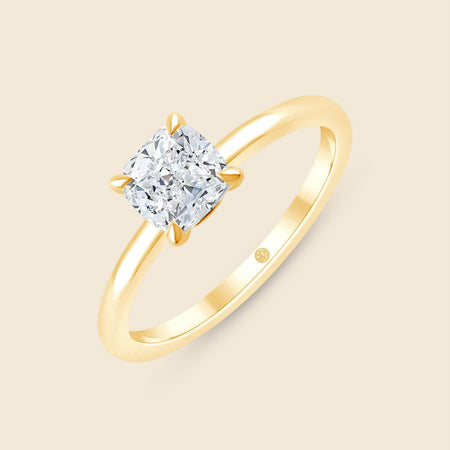


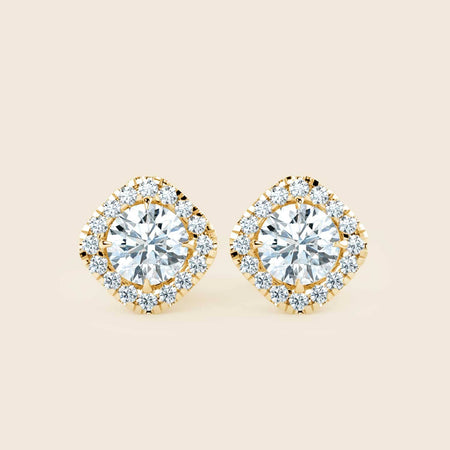
What is the best way to show off the cushion cut in a ring or other piece of jewelry?
The cushion cut unfolds its full effect particularly well in a high-quality engagement ring. As a solitaire in a prong setting, ideally with four prongs, the shape of the stone is perfectly emphasized and receives maximum light incidence. A ring band in platinum or rose gold enhances the elegant character and complements the timeless radiance of the gemstone.
Equally popular is a halo design in which small brilliant-cut diamonds surround the central cushion cut diamond. A frame like this makes the piece of jewelry appear larger, more eye-catching and more radiant - ideal for anyone who likes to wear a highly sparkling highlight. Designs with three stones are also an elegant way to showcase the cushion cut and introduce additional symbolism.
Colored variants, such as yellow diamonds, are particularly effective in this cut, as the facets intensify the color. Regardless of the chosen style, a cushion cut diamond always looks elegant, stylish and harmonious.

Advantages and disadvantages of Cushion brilliant and Cushion modified brilliant
The Cushion Cut offers an exceptionally harmonious blend of classic brilliant cut and geometric shapes, making it a particularly elegant and versatile cut. One of its greatest advantages is the soft, romantic radiance created by the rounded corners and deep facets. Many people appreciate the fact that it is available in different proportions, square or rectangular, and can therefore be perfectly adapted to the personal design of an engagement ring. Cushion cuts are also considered to be extremely secure in the setting, as the corners are not as sensitive as with other angular shapes. Variants such as the Cushion Brilliant achieve an impressive brilliance, while the Cushion Modified Brilliant with its characteristic "crushed-ice" effect offers an exceptionally lively play of light structure.
However, the Cushion Cut also presents some challenges. The quality of the sparkle depends heavily on the craftsmanship of the cutter, which is why large differences can occur between individual stones. With less excellent cuts, the diamond can lose its brilliance or appear uneven. In addition, a cushion cut may show inclusions more clearly than a classic brilliant cut, which is why clarity and proportions play a particularly important role. The carat weight also has a strong influence on the appearance; a stone that is too flat or too deep will appear smaller or allow light to escape. Anyone opting for this cut should therefore attach great importance to careful selection and an eye for detail, as only a precisely cut cushion cut will reveal its incomparable quality and elegance.

Funfact:
The cushion cut is a cut of historical and modern significance: it has left its mark on history with legendary jewels such as the 45.52-carat, deep blue Hope diamond, which is considered one of the most valuable rarities in the world. At the same time, it gained enormous popularity in the modern celebrity world through the 15-carat, rectangular cushion cut of Kim Kardashian's engagement ring. Both examples impressively demonstrate the range of the cushion cut, from historical depth to contemporary glamor.
Frequently asked questions
The cushion cut is a traditional diamond cut that has a square or rectangular shape with rounded corners (like a cushion) and large facets, giving it a blend of historical elegance and high brilliance.
The ratio is pure preference:Square (Classic): An L/W ratio of 1.00 to 1.05 makes the stone look almost perfectly square.Rectangular (Elongated): An L/W ratio of 1.15 to 1.20 gives a more elongated appearance. This shape is considered very flattering as it visually elongates the fingers.
No, in fact the opposite is the case. The cushion cut tends to show more color than a round brilliant or princess cut. Therefore, when buying a cushion cut, especially in white gold or platinum, experts recommend choosing a higher color grade (G or better) to ensure that it appears white.
There are two main variations of the modern cushion cut. The "Chunky Look" (clear spark) is similar to the historical cut and produces broad, clear flashes of white light. The "crushed ice look" has additional facets that create a denser pattern of many small, glittering reflections, similar to crushed ice. The choice is purely a matter of taste.
Yes, the cushion cut is usually less expensive than a round brilliant of comparable carat count and quality. This is because the cushion cut wastes less rough diamond material during the cutting process, making it more efficient for the cutter and less expensive for the buyer.
Conclusion: The timeless cushion cut
The cushion cut is a cut that combines vintage charm, modern sophistication and timeless elegance. A cushion cut diamond radiates warmth, depth and brilliance and looks incomparably romantic thanks to its square or rectangular shape with rounded corners. Whether in a classic solitaire, a glamorous halo or in combination with three stones, a cushion cut engagement ring is a particularly elegant and popular choice for couples looking for a piece of jewelry that is both stylish and unique. An exquisitely cut cushion cut offers an impressive reflection of light and shows that timeless beauty and modern elegance need not be mutually exclusive.
If you want a ring that combines history, brilliance and personal style, the cushion cut is undoubtedly one of the most beautiful options and a truly remarkable symbol of love.