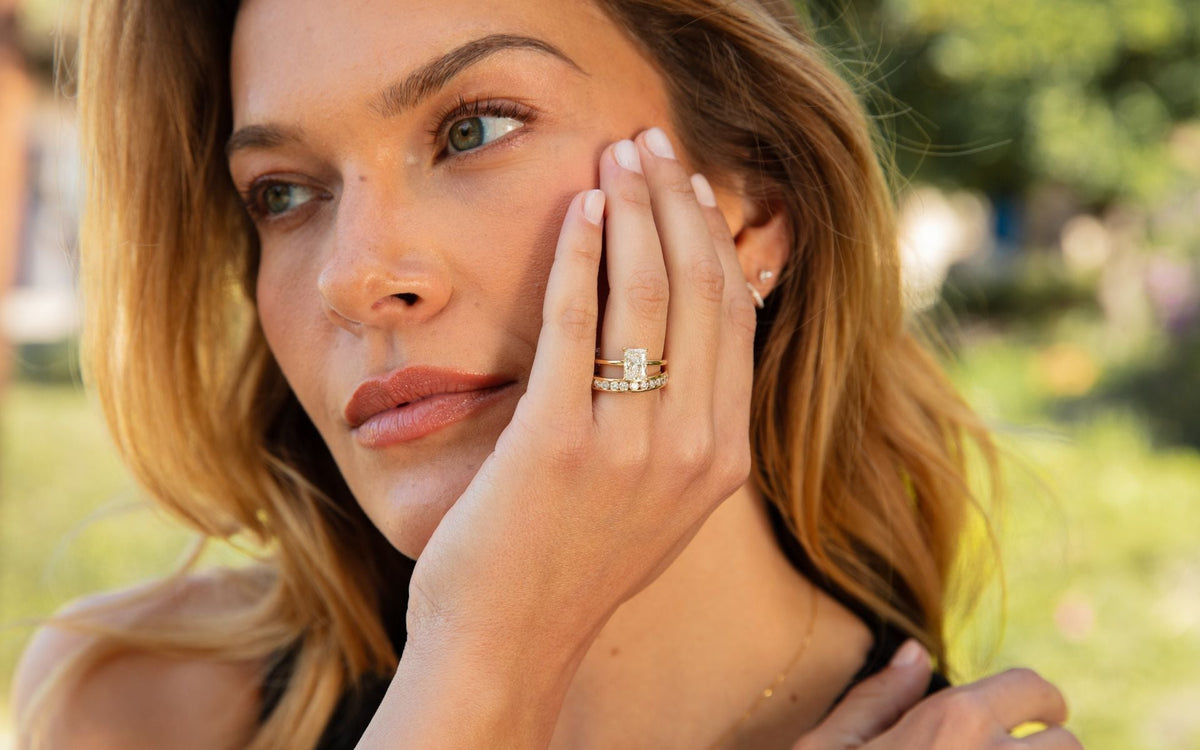

The baguette cut - makes your diamond sparkle
The baguette cut diamond is ideal for you if you prefer simple elegance and clear lines in your jewelry. It is one of the most classic and elegant cuts in the diamond world. It owes its name to the French word "baguette", which means "little stick" , which it resembles with its rectangular shape and long, narrow facets that reflect the light in even, subtle rays. Unlike the sparkling brilliant cut or the deep Asscher cut, the baguette cut focuses less on the intense brilliance of the gemstone and more on geometric precision
The most important things at a glance
Features of the baguette cut
Find out what characterizes the cut and what distinguishes it from other cuts.
Learn more
History and significance for jewelry
Here you can find out how the baguette cut came about and what special role it plays in the history and design of jewelry.
Learn more
Baguette diamonds in jewelry How the cut enhances the quality of your piece of jewelry
Learn how baguette diamonds significantly enhance the overall effect and value of a piece of jewelry thanks to their clear shape and precise lines.
Learn more
Advantages and difficulties of the baguette diamond
This section highlights both the elegant advantages of the baguette diamond and the special challenges that its precise cut entails.
Learn more
Features of the baguette cut
Unlike the brilliant cut, which is intended to create maximum brilliance and light reflections, the baguette cut focuses on simple clarity and geometric precision. Typically, a baguette diamond has 14 to 24 facets, which are arranged flat to create a soft, even sparkle. As the surface of the stone is large and open, only particularly pure diamonds are used in the baguette cut, as inclusions or impurities would otherwise be visible to the naked eye. Its clear structure emphasizes the color and quality of the stone, which makes it particularly suitable for fine jewelry designs in platinum, white gold or rose gold.
The baguette cut is distinguished above all by its narrow, elongated shape and its simplicity. While asscher and emerald are both step cuts with many facets (57-58), the baguette often has only 14 facets and hardly any sparkle. The asscher creates a dramatic "hall of mirrors" effect with its cut corners and deep steps. The emerald is wider and rectangular, less dramatic than the asscher but more elegant than the baguette. While Asscher and Emerald are often used as the main stones, the Baguette is almost always a companion stone - it is too plain and narrow to work on its own.

History and significance for jewelry
The baguette cut has its roots in the 16th century. Its predecessor was the"hogback" cut, an elongated diamond shape with a raised point or simplified top. Back then, these narrow stones were mainly used for monograms and initials, which served as status symbols. When diamond cutters began to flatten the pointed top of the hogback, a shape with a large table facet and geometric outline emerged - the baguette cut.
It owes its name to the French: The word "bague" meant "jewel" in general until the 17th century, and "baguette" is the diminutive form - i.e."little jewel". The modern version was reintroduced by Cartier in 1912. The baguette cut experienced its heyday in the 1920s and 1930s during the Art Deco movement. The clear, geometric lines and minimalist design of the cut perfectly suited the Art Deco aesthetic, which was enthusiastically received in Western society. During this period, the baguette was often the main stone of a piece of jewelry, with many stones being joined together in intricate, precise patterns.
Today, the baguette is mainly used as a companion stone and is considered a timeless classic, combining modern simplicity with vintage charm.
Did you know?
The baguette cut was originally used primarily for watches! Its elongated, rectangular shape fitted perfectly into narrow dials and only later became a popular style in rings and necklaces. To this day, it is considered a symbol of simple, architectural elegance.
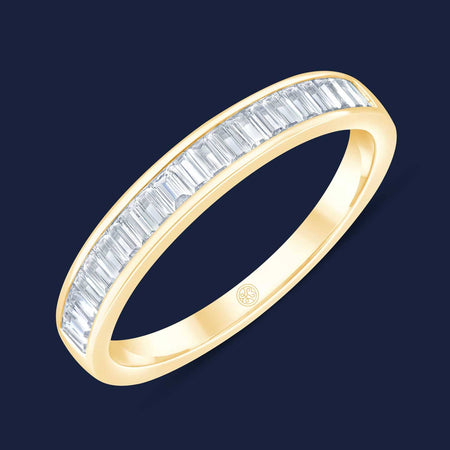


Baguette diamonds in jewelry: How the cut enhances the quality of your piece of jewelry
Baguette-cut diamonds are particularly popular in engagement rings and diamond rings or on necklaces as a companion stone, where they set off the main stone in an unusually beautiful way. It often works in combination with a central diamond, for example a brilliant, princess cut or asscher cut. Thanks to its clear lines, the baguette cut suits both modern and classic designs and adds a stylish, understated touch to any piece of jewelry. Whether as a solitaire or as a side stone in an engagement ring, it is a pure understatement that perfectly complements both modern and Art Deco-inspired pieces of jewelry.
Baguette diamonds are also popular in exclusive pieces of jewelry such as earrings or bracelets, as they fit perfectly into linear settings. Thanks to different widths and lengths, individual designs can be created, whether delicate accents or striking geometric compositions.

Advantages and difficulties of the baguette diamond
Due to the flat shape, the stone often appears larger than the carat weight (ct) would suggest, which is advantageous if you want an impressive diamond on your ring. As already mentioned, the baguette diamond can also be perfectly combined with other cut shapes. Its narrow shape makes your fingers look longer. The small number of 14 facets means that less dirt collects and it is cheaper to produce than sparkling brilliant-cut diamonds.
However, this cut requires the highest precision and careful selection of the rough stone, as with other cuts (e.g. the emerald cut), which have few facets for a long time, as inclusions and color are easier to see. As the flat facets refract less light, the brilliance is lower than with the classic brilliant cut - but the clarity of the stone is all the better.
Tip:
If you choose a baguette-cut gemstone, pay particular attention to the clarity. As the cut has large, open facets, inclusions are much more visible than in brilliant cuts. A slightly smaller but clearer stone often looks higher quality than a larger one with flaws.

Frequently asked questions
The baguette cut is an elongated, rectangular step cut with straight lines and few, large facets - ideal for clear, elegant light reflections.
Due to the step-cut structure, they have fewer facets, which makes them shine rather than sparkle - they show "flashes" instead of strong sparkle.
Purity is particularly important, as inclusions are easily visible. In addition, the proportions should be symmetrical and the edges cleanly polished.
They are perfect as side stones for engagement rings, in eternity rings or in geometric, Art Deco-inspired designs.
Yes, the long, sharp edges can be more susceptible to chipping. A stable frame, such as a channel frame, offers optimum protection.
Conclusion: Baguette polish and its French charm
The baguette cut is the perfect choice for anyone who appreciates subtle elegance and clear shapes. Its rectangular structure, fine facets and subtle sparkle give engagement rings, diamond jewelry or wedding rings an unmistakable radiance. Whether as a central piece of jewelry or in combination with other diamonds, the baguette diamond is a symbol of taste, style and timeless beauty.