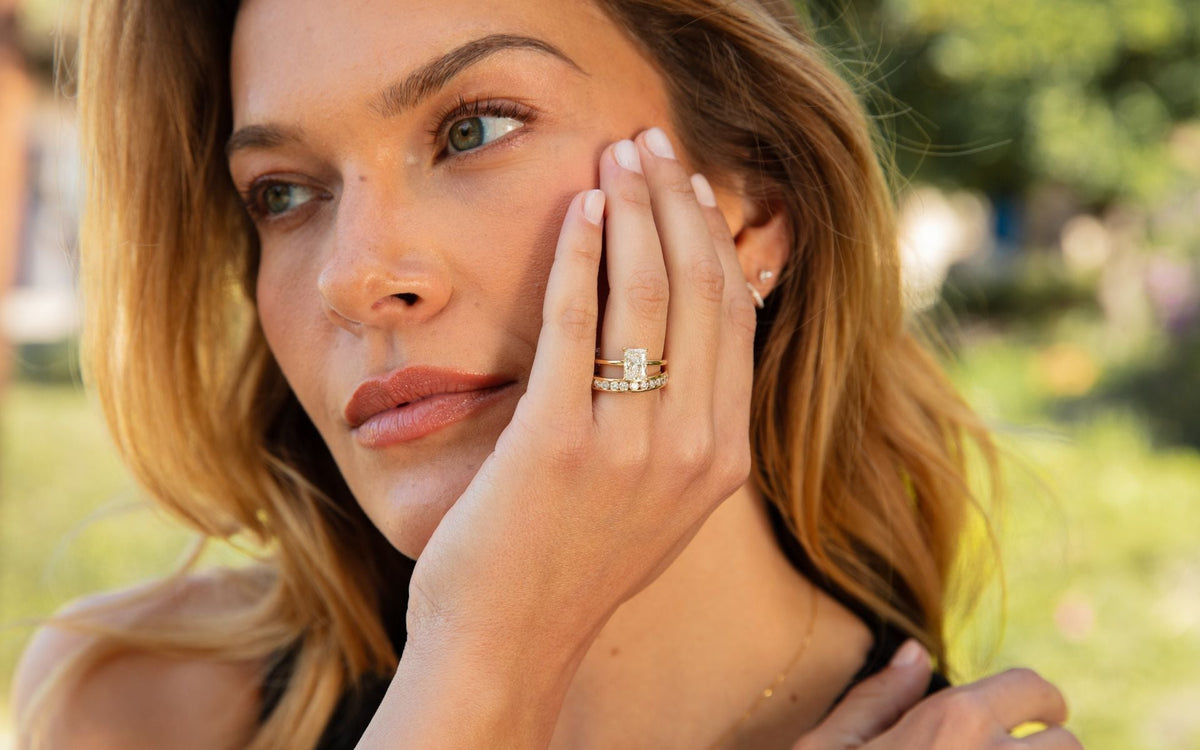

Princess Cut - modern shape and brilliance combined in a diamond

Discover the princess cut, which bears its name for a reason, as it gives your diamond a royal look. It is one of the most popular diamond shapes for engagement rings and solitaires today. Its clear, square shape combines the firepower of the brilliant cut with a modern, geometric aesthetic and is particularly suitable for pieces of jewelry that combine brilliance and timeless clarity.
The most important facts at a glance
Characteristics of a princess cut diamond
Discover the shape, proportions and special features of the princess cut.
Learn more
Cut and appearance of the princess cut: brilliance, sparkle and shape
Find out what makes a good princess cut.
Learn more
Origin and predecessor of the Princess diamond
Learn more about the origins of the Princess Cut as we know it today.
Learn more
Advantages compared to round diamonds
Why the cut might be just right for you!
Characteristics of a princess cut diamond
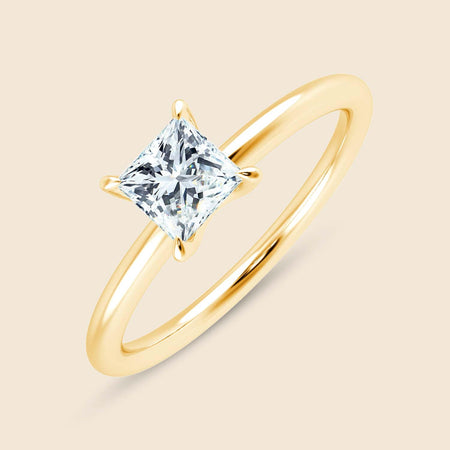
The princess cut is a slightly more modern cut and is basically a modified brilliant cut with a square or rectangular basic shape. Princess diamonds are cut in a pyramid shape so that the upper side resembles a round brilliant in its faceting, while the underside is an inverted pyramid. As with a brilliant, the typical number of facets is 57. However, a princess cut diamond can be extended up to 76 facets. Variants with 57 facets are strongly reminiscent of the brilliance of the classic brilliant cut, while 76-facet variants can further vary the sparkle. The proportions are usually square or slightly rectangular. With a larger ratio, princess-cut diamonds are often referred to as rectangular. Due to the pyramid-like underside, less material is lost with the princess cut than with the brilliant cut, for example, which is why the carat weight in the end product often remains advantageous.

Cut and appearance of the princess cut: brilliance, sparkle and shape
As previously mentioned, the combination of many small facets and the geometric side surface of the princess cut ensure that the diamond has a great deal of brilliance and fire, often comparable to a round brilliant if the ideal proportions are maintained. However, the characteristic pointed corners of the princess diamond are more sensitive than rounded edges, which is why many settings use beveled or rounded corners to prevent breakage or damage. Because inclusions are often better concealed in the princess cut thanks to the additional facets, small inclusions are less distracting to the naked eye than with some other cuts. The ideal proportions of a princess diamond influence its brilliance and price. The cut quality, the ratio of table to depth and the design of the underside (inverted pyramid) determine how strongly the stone reflects light. The roundness plays a different role for angular shapes than for round diamonds, but a clean, symmetrical design is still crucial for good sparkle.
Did you know?
With engagement rings from Pukka Berlin, you can have your Princess Cut ring engraved free of charge. In addition, subsequent size adjustments up to two sizes are included in the price. If you are still unsure about your choice of engagement ring, we will be happy to advise you in a personal consultation. Book an appointment here!
Origin and predecessor of the Princess diamond
The princess cut is a comparatively young cut shape in the long history of diamond cutting. Its roots lie in the middle of the 20th century, when diamond cutters began to develop angular shapes that combined the brilliance of a round brilliant with the modern, geometric aesthetics of a square. The so-called barion cut , which was patented in 1971 by South African gem cutter Basil Watermeyer, is considered the direct predecessor of the princess cut. At the time, the barion was a revolutionary combination of step cut and brilliant cut, in which light reflections were maximized by cleverly arranged facets. This was followed shortly afterwards by similar developments such as the Quadrillion Cut and the Profile Cut, which were further refined in Israel and the USA in the 1970s. These early variants are now considered the "prototypes" of the modern Princess Cut.
The final form as we know it today, the square modified brilliant cut, became popular in the early 1980s. It combined the optical brilliance and sparkle of a round brilliant with the clear, angular shape of a square diamond. The princess cut was ideal for rough diamonds with the shape of an octahedron, as it enabled a high level of material retention. In contrast to the round brilliant, significantly less substance was lost during cutting. This made the cut shape not only aesthetically but also economically attractive.
From the very beginning, the princess cut was mainly used for engagement rings and diamond jewelry, as it looks both modern and luxurious. Compared to older cuts such as the rose cut, old cut or Asscher cut, the princess cut embodies the transition to a new era of diamond cutting, characterized by precise cutting technology, standardized proportions and mechanical perfection. Today, the princess cut is one of the most popular diamond shapes worldwide, especially in solitaire settings, wedding rings and contemporary jewelry, and is considered a symbol of modern romance and clear elegance.
Advantages compared to round diamonds

Lower carat price
Compared to a round brilliant cut diamond, the princess cut often offers a very similar brilliance with similar clarity and color, while at the same time it is often less expensive than a round diamond of the same carat weight because less raw material is lost during cutting

Lamination of inclusions
Small inclusions can also be concealed much better by faceting. As a result, the princess cut often offers a more attractive price-performance ratio than a round brilliant with the same carat weight.

Versatility
The princess cut is ideal for modern engagement rings, eternity rings and many other pieces of jewelry because they can be placed next to each other without gaps. Whether as a pavé setting or as a solitaire in a simple setting, the princess diamond is always an eye-catcher.

Ring material
In classic jewelry designs, they are often set in white gold, yellow gold or platinum, which gives them a royal appearance. For solitaire settings, a setting that protects the corners is recommended so that the diamond loses none of its brilliance in everyday life.
Disadvantages compared to round diamonds
Unfortunately, the pointed corners of the princess diamond are very sensitive and can easily break off if the setting is unsuitable or subjected to heavy impact. A protective prong or bezel setting is therefore often indispensable. In addition, the cut reacts sensitively to deviations in proportions and cut quality, which can lead to a loss of brilliance or cause light leaks even in the case of minor flaws. Even if the princess cut shows a lot of fire, its light distribution is less even than that of the round brilliant, which can lead to slightly less "depth" in the sparkle in certain lighting conditions.
Tip:
With the princess cut, you should pay particular attention to the quality of the corners, as they are more sensitive than with round cuts - a good setting protects them and allows the diamond to sparkle optimally.
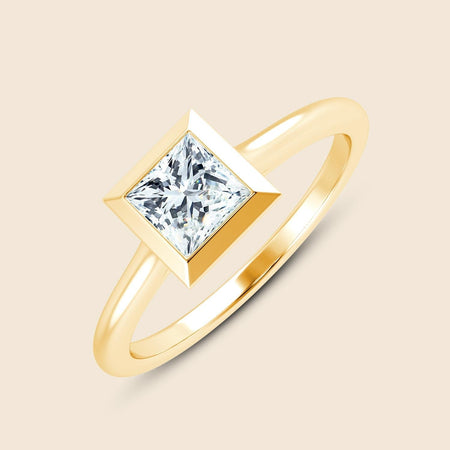
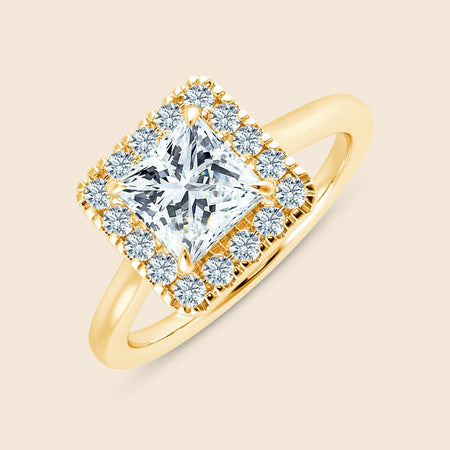
Discover engagement rings in the Princess Cut by Pukka Berlin

Frequently asked questions
The princess cut is a square or slightly rectangular diamond cut with many facets that is known for its intense sparkle and modern, clear shape.
It combines the brilliance of a round brilliant-cut diamond with a straightforward, geometric shape, making it both elegant and modern.
Most princess diamonds have between 50 and 58 facets, which creates their typical radiant shine.
It sparkles very strongly, but differently: the princess cut has a somewhat "sharper", more geometric sparkle compared to the round brilliant.
A four-crown or six-crown frame is most commonly used to provide the best possible protection for the corners.
Pay attention to symmetry, well-proportioned edges, minimal inclusions in the corners and a high cut quality to achieve maximum brilliance.
Conclusion
The princess cut combines the brilliance of the classic brilliant cut with a modern, square diamond shape. Whether as a princess diamond in an engagement ring, as a solitaire or in band rings, it offers a strong visual presence, good brilliance and often a more favorable ratio of carat weight to price compared to round diamonds. However, cut quality, a suitable setting and a reliable certificate are crucial for the perfect result - then nothing stands in the way of the timeless, clear beauty of this modern classic.